Producing biologicals on the farm: what the law allows and how to ensure quality
Production for on-farm use is permitted by law and lowers the cost per hectare. What separates a good result from a contaminated tank is the process.
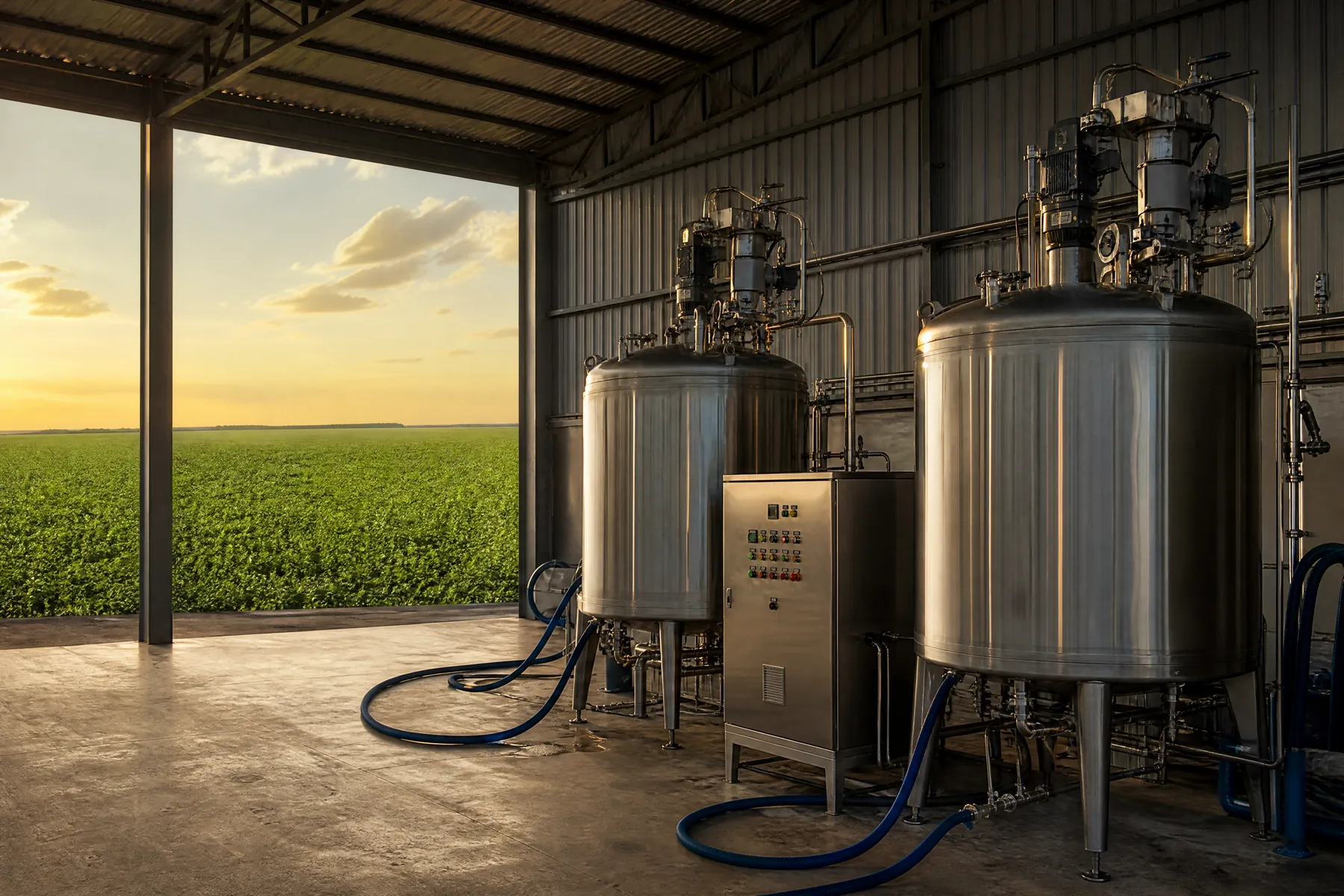
Multiplying beneficial fungi and bacteria in a bioreactor on the property, known as on-farm production, has become a reality on many farms in Mato Grosso. The reason is simple: the same microorganism as in the ready-to-use product comes at a fraction of the cost per hectare. But the savings only materialize if what comes out of the tank is, in fact, the right microorganism.
What the law allows
Law 15.070, signed in December 2024, created specific rules for biological inputs in Brazil. For growers who produce on the farm, the main points are:
- production of biological inputs for on-farm use is authorized and exempt from registration;
- sale is prohibited: what is produced stays on the property;
- the law provides for a simplified registry of production units, with an exemption for family farming;
- cooperatives, associations and grower consortia may also produce under this regime;
- importing biological inputs for on-farm use is prohibited.
Details such as the registry, the required good practices and the need for a technical lead depend on the law's implementing regulations, which the Ministry of Agriculture was discussing in 2026. Before setting up your unit, check the rules in force on the MAPA website.
The risk few people see: contamination
A bioreactor is a perfect environment for microorganisms to grow. All of them, including the ones you don't want. Embrapa research with samples collected on farms showed the size of the problem:
- samples of Bacillus produced on farm in Mato Grosso and Goiás had a high rate of contamination by other bacteria;
- in Bradyrhizobium and Azospirillum inoculants made on the farm, the target microorganisms barely appeared, and there were contaminants, some with antibiotic resistance;
- in another survey, some samples suggested contamination by Salmonella and thermotolerant coliforms.
A 2025 study helped explain the source: contaminants present in the inoculum remained present until the end of the process, favored by the conditions in the bioreactor. In other words, starting with the wrong inoculum compromises the entire batch.
Embrapa researchers make it clear that they are not against on-farm production. What they advocate is a quality product, a qualified technical lead and proof of the final product's quality.
How to do it right
- Inoculum of known origin. A selected, pure strain with a lab report. Never use the previous batch as the starter for the next.
- Tank asepsis and treated water. Bioreactor cleaning, water chlorination, chlorine neutralization before inoculation and adjusted pH.
- The right culture medium for each microorganism, in the amount specified in the protocol.
- Control during fermentation. Temperature, pH and aeration monitored throughout the 48 to 72 hours of the process.
- Analysis of every batch before it goes to the field, to confirm concentration and the absence of contaminants.
- Storage and prompt use. Below 20 °C and applied within the time frame set in the protocol.
- A technical lead overseeing the process and a team trained for it.
Is it worth it?
Done with a proper process, yes. The difference in cost per hectare between the ready-to-use product and the one multiplied on the farm is usually large, and you can simulate yours in the savings calculator. What is not worth it is cutting corners on the inoculum and quality control, because a contaminated batch costs you the application, the window and sometimes the crop.
How On Farm Bio works
The On Farm kits include the inoculum of the selected strain, the culture medium and the preparation inputs. They come with the bioreactor, team training, the asepsis protocol and technical support for every batch. See the complete step-by-step in the On Farm System.
The technical team will recommend the product and management for your case.